




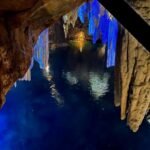



















Pukaway Cave — Coron’s secret underground lake (Palawan, Philippines)
Hidden behind dramatic limestone cliffs and hugged by the same turquoise water that made Coron famous, Pukaway Cave is the kind of place that makes you say, “I can’t believe this is real.” Part cave, part cenote, part secret swimming hole, it’s a small, magical pocket of calm tucked just beside better-known attractions like Kayangan Lake — but with a mood all its own. Expect narrow passages, an iron ladder descent, and luminous, brackish water that glows when stray sunlight and tour lights catch the stalactites.
Pukaway only opened to visitors recently (first reports to the public surfaced around 2023), so it still feels like a fresh discovery rather than a polished tourist trap. That means fewer crowds, simpler facilities, and tours that often include island-hopping, snorkeling and lunch on quiet beaches — ideal for travellers who like their paradise with a side of discovery.
Adventure-seekers: be ready to squeeze, climb and swim. Pukaway’s entrance can be physically demanding (a ladder down a vertical shaft and narrow cave passages). The payoff is a surreal swim in an underground lake surrounded by limestone formations and echoing silence — perfectly Coron.
Where it is and how to reach Pukaway Cave
Pukaway Cave is on Coron Island, part of the Calamian Islands in northern Palawan province of Philippine. It sits very close to Coron’s famous inland lakes (Kayangan and Barracuda/Twin Lagoon areas), reached by boat from Coron town (mainland Busuanga). Many island-hopping tours list Pukaway as a stop in a “Coron Island” or combined cave + snorkel itinerary.
Nearest major airport: Francisco B. Reyes Airport (Busuanga / IATA: USU). That’s the air gateway for Coron town and the usual jump-off point for island-hopping boats to Coron Island. Busuanga airport has multiple daily domestic flights (mostly from Manila) operated by Philippine Airlines, Cebgo / Cebu Pacific and smaller carriers. From Coron town you’ll board a local banca (boat) — many tours provide pick-up from your hotel and the shared boat transfer.
In order to get there, you will fly from UK to Manila Philippine), Common carriers include Emirates, Qatar, Cathay Pacific, Philippine Airlines and other one-stop carriers. Most routes involve one stop in the Middle East or Asia.
From Manila, take the domestic flight to Busuanga (Philippine Airlines, Cebgo/Cebu Pacific, Sunlight Air/AirSWIFT depending on schedule). And finally, from Busuanga airportn, it’s a 20–45 minute drive to Coron town and then boats to Coron Island.
Accommodation, transport and typical tour costs
Coron town (Busuanga) is the base for day tours — it offers a full range of accommodation from budget hostels and mid-range hotels to island resorts (some resorts sit on nearby islands or Busuanga itself). Expect comfortable guesthouses from budget to boutique; luxury diving resorts are available on Busuanga/nearby islands if you prefer a resort base.
Transport on arrival
- Domestic flight to Busuanga (USU) → taxi/van to Coron town → boat tour to Coron Island.
- Within Coron town you’ll find tricycles, minibuses and local vans for short transfers; boats are arranged by tour operators for island trips. Many tour operators include hotel transfers.
Small entrance fees, environmental fees, or docking fees may be charged separately at particular islands or managed sites. It is advisable, therefore, to bring cash (Philippine pesos). Because Pukaway is a relatively new, privately managed open-to-tourists site, details and fees can change quickly.

The Philippines as a tourist destination
The Philippines is a mid-range to budget-friendly destination for many travellers, but costs vary widely by style and location. Airfares would be the biggest expense — once you’re in the Philippines, domestic travel, food, and budget accommodation are often very affordable. Island resorts, private tours, and high-season prices can push a trip into a pricier bracket.
Highlights that affect price:
- Many independent travellers live cheaply (guesthouses, local eateries, public boats).
- Popular islands (El Nido, Coron, Boracay) have premium options and can cost more for private tours, resorts and peak-season bookings.
- Diving, private island transfers, and luxury resorts add significantly to the budget. Pukaway offers relatively affordable day tour options, especially if you choose shared tours.
If you plan smart (book long-haul flights in advance, use shared boats, choose mid-range hotels), you can keep costs moderate; if you want private boats and high-end resorts you should budget for it.
Is Pukaway Cave natural or artificial? History & interesting facts
Pukaway Cave is natural — a karst limestone cave that contains a flooded (brackish) underground lake. The cave is formed by limestone dissolution and coastal inundation; visitors descend a ladder into a shaft and swim in crystal clear water surrounded by stalactites and rock formations. It’s not man-made.
Pukaway was recently opened to the public (reports of opening to tourists began circulating around 2023), previously being private land. That recent opening is why it still feels ‘undiscovered’ compared with Kayangan Lake or Twin Lagoon.
It sits close to Coron’s inland lake cluster (Kayangan, Barracuda/Twin Lagoons), an area managed and protected under the Coron Island Protected Area; indigenous Tagbanwa stewardship and local regulations shape access and conservation in the area.
Physically demanding: entry often requires climbing down a long iron ladder into a narrow shaft — not ideal for very young children, people with serious mobility issues, or severe vertigo. Guides typically provide life vests and basic lighting. ShowCaves and traveller reports note the ladder and narrow descent as a defining part of the visit.
Practical planning (from UK):
Visas & documents (British travellers)
UK passport holders do not need a visa for short tourist visits of up to 30 days to the Philippines — but you must have a return or onward ticket and a passport valid for at least six months on arrival. If you plan to stay longer than 30 days, apply for a visa in advance. Check the Philippine DFA / eVisa page and the UK FCDO travel advice regularly before travel.
Flights & routing
Typical routing: London → Manila (long-haul, one stop) → Manila → Busuanga (USU) domestic flight. Airlines for the long leg include Middle Eastern and Asian carriers (Emirates, Qatar, Cathay Pacific, Singapore Airlines, etc.); domestic carriers for MNL–USU include Philippine Airlines and Cebgo/Cebu Pacific. Book domestic connections with sufficient layover time (allow for delays).
Health & insurance
It is advisable to get travel insurance that covers diving and water activities if you plan to snorkel or dive. Many standard policies exclude scuba or higher-risk activities; consider specialist dive insurance (DAN or dive-specific add-ons). Also be up to date with routine vaccines; hepatitis A and typhoid are commonly recommended for travellers to the Philippines — see NHS/travel health clinics for personalised advice. Yellow fever vaccine is not required unless you’re coming from a yellow-fever risk country.
Money & payments
Coron town accepts cards in larger hotels and resorts but bring cash (PHP) for small operators, market food, and local fees. Small entrance or environmental fees at island sites are often cash only. ATMs exist in Coron town but can be limited. Plan accordingly.
Safety & weather
Peak season for Coron (best visibility for diving and drier weather) is January–May. Typhoon/wet season is typically June–November — if you travel during the rainy season, expect occasional cancellations. Check FCDO travel advice for safety info and local notices.
Packing & fitness
It would be a good idea to bring reef-safe sunscreen, water shoes (for cliffs and jagged limestone), a torch/headlamp, and a small dry bag. You must be prepared for a ladder descent and some climbing — moderate fitness helps. Guides will advise on life vests and safety.
Why Pukaway deserves your bucket list
Pukaway Cave is the kind of discovery that makes Coron keep delivering surprises: a natural, karst underground lake you can actually swim in, with fewer crowds and a raw, slightly wild energy that most polished attractions lack. It’s perfect as a day-trip add-on to Coron’s classic island-hopping loop, and for anyone who loves caves, swimming in luminous water, or simply bragging rights about having found something new. If you’re travelling from the UK: plan your long-haul and domestic legs in advance, pack sensibly, and you’ll be rewarded with a surreal swim inside a limestone secret — Coron’s quieter, moodier cousin to the famous lagoons.
