























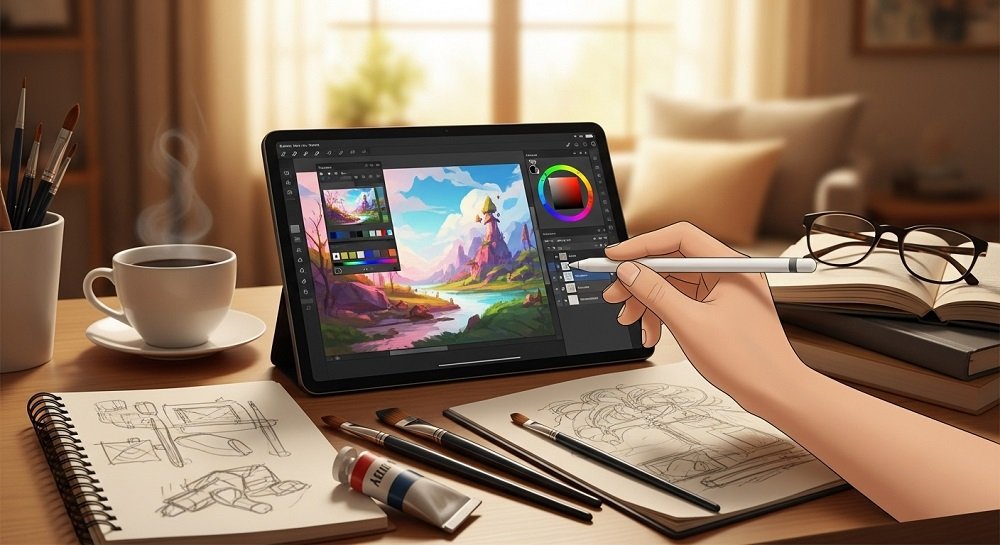
Beginner’s Guide to Digital Painting
Digital painting has quietly reshaped how art is created, shared, and even understood. In the UK, where creative industries intersect daily with technology, more beginners are turning to tablets and styluses instead of canvases and brushes. This is not merely a trend; it reflects a broader shift in how visual creativity adapts to contemporary life. As an editorial opinion, this guide argues that digital painting is not an easier shortcut to “real art”, but a legitimate discipline that demands structure, patience, and artistic literacy.
This beginner’s guide is written for those standing at the threshold: students, hobbyists, career-switchers, or curious creatives who want a grounded, honest overview. It avoids commercial hype and focuses instead on fundamentals, habits, and decision-making. While the UK context is emphasised—education, work culture, and creative pathways—the principles discussed apply globally.
What Digital Painting Really Is (and What It Is Not)
At its core, digital painting is the practice of creating artwork using digital tools while applying traditional art principles. The misunderstanding begins when beginners assume software replaces skill. In reality, software merely extends the surface on which decisions are made. Composition, colour theory, lighting, anatomy, and perspective remain non-negotiable.
Unlike photo manipulation or graphic design, digital painting is not about assembling existing elements. It is about constructing form, mood, and narrative from nothing. The digital medium allows undo buttons and layers, but these conveniences do not substitute observation, practice, or artistic judgement.
Editorial Note: Beginners often progress faster when they stop treating digital painting as “software learning” and start treating it as “visual problem solving”.
Choosing Your Digital Painting Setup: A Practical Perspective
Beginners frequently overthink equipment. In the UK market, access to technology is relatively strong, but this does not justify excessive upfront investment. A basic setup is sufficient for learning fundamentals.
Hardware Considerations
A pressure-sensitive tablet or a tablet computer with a stylus is the foundation. Screen size matters less than responsiveness and comfort. For beginners, the priority should be ergonomics and consistency rather than brand prestige.
Software Mindset
Software choice influences workflow but not artistic potential. Beginners benefit from learning one tool deeply rather than sampling many superficially. What matters most is access to brushes, layers, and colour control.
Core Skills Every Digital Painter Must Learn
Digital painting rewards structured learning. The following skills form the backbone of progress and should be revisited continuously.
- Line confidence and stroke control
- Basic perspective and spatial awareness
- Light and shadow logic
- Colour harmony and temperature
- Edge control and brush economy
In the UK education system, art fundamentals are often fragmented across courses. Self-directed learners must therefore be intentional about revisiting basics rather than chasing stylistic shortcuts.
Developing a Sustainable Practice Routine
The most under-discussed aspect of digital painting is routine. Beginners often rely on bursts of motivation, which leads to inconsistent progress. A sustainable practice routine values frequency over duration.
From an editorial standpoint, the UK’s work-life balance discourse should encourage artists to adopt realistic schedules. Thirty to sixty minutes of focused practice, several times a week, consistently outperforms irregular long sessions.
Practice Structure Example
Weekly Beginner Practice Framework
| Day | Focus Area |
|---|---|
| Monday | Sketching and line control |
| Wednesday | Shading simple forms |
| Friday | Colour studies |
| Weekend | Personal artwork or studies |
Common Beginner Mistakes (and Why They Persist)
Mistakes persist not because beginners lack talent, but because digital tools obscure feedback. Overuse of brushes, excessive layers, and avoidance of fundamentals are common traps.
Question: Is copying other artists harmful?
Answer: Copying for study is essential. Copying for identity replacement is the problem.
Digital Painting as a Long-Term Skill
Digital painting should be approached as a long-term craft. Whether your goal is personal fulfilment or professional contribution, patience remains the defining variable. In the UK’s competitive creative economy, consistency and skill depth matter more than visibility.
From an editorial perspective, digital painting deserves the same respect as traditional disciplines. It is not a lesser form, nor is it inherently easier. It is simply modern.
Final Thoughts
This beginner’s guide to digital painting has deliberately avoided shortcuts and exaggerated promises. The digital medium is powerful, but only when guided by intention, discipline, and understanding. For beginners in the UK and beyond, the real advantage lies not in tools, but in mindset.
Learn slowly. Practice deliberately. Respect fundamentals. Digital painting will reward you accordingly.
