























Cricket today stands among the most passionately followed sports in the world, revered in countries as diverse as England, Pakistan, Australia, New Zealand, Sri Lanka, Bangladesh, South Africa, Zimbabwe, India, the Caribbean islands and many other countries. Yet its beginnings were far humbler—born not in packed stadiums under floodlights, but in quiet English village greens where shepherd boys once tapped stones with crooks.
This article traces the remarkable evolution of cricket, explains how its structure is organized—especially in the United Kingdom—outlines how the game is played, and recalls the champions who have lifted the One Day International World Cup trophy.
Cricket is believed to have originated in southeast England during the medieval period. The earliest definite reference to cricket dates back to 1598, recorded in court documents describing it as creckett, a pastime of schoolboys. By the 17th century, adults had adopted the game, and it began spreading across rural counties.
Its growth accelerated in the 18th century, coinciding with England’s rise as a global colonial power. British sailors, soldiers, and traders introduced cricket across the empire—from South Asia to the Caribbean and Africa. The sport found fertile ground particularly in India, where the Parsi community in Bombay took it up enthusiastically in the early 19th century. Soon, local clubs emerged, laying the foundation for what would become a cricketing superpower.
By the late 1800s, international competition began to take shape. In 1877, Australia and England played what is recognized today as the first Test match, sparking one of the sport’s longest and most emotional rivalries: The Ashes.
GOVERNING THE GAME: INTERNATIONAL AND NATIONAL AUTHORITY
The International Cricket Council (ICC)
The global governing body for cricket is the International Cricket Council, originally formed in 1909 as the Imperial Cricket Conference. Renamed in 1965 (and again in 1989), today’s ICC oversees international matches, rankings, umpires, and major tournaments, including:
- The ICC Men’s and Women’s Cricket World Cup
- The ICC T20 World Cup
- The ICC World Test Championship
The ICC regulates playing conditions, disciplinary codes, and global development programs.
ENGLAND AND THE UNITED KINGDOM: THE HOME OF COUNTY CRICKET
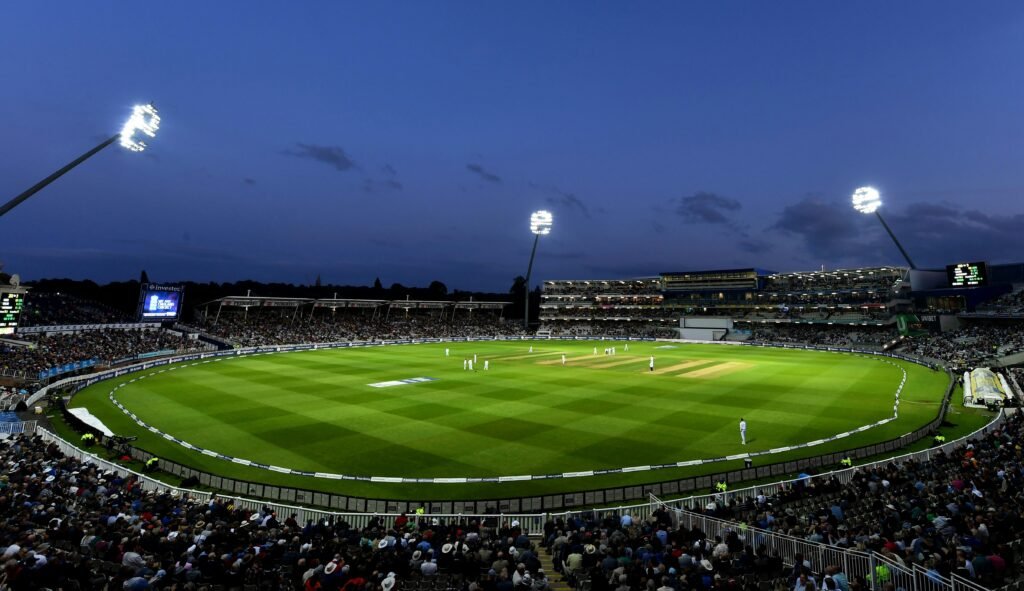
England, as the birthplace of cricket, maintains a deeply structured domestic system. The national governing body is the England and Wales Cricket Board (ECB), which oversees:
- The national England cricket teams (men’s and women’s)
- County cricket competitions
- Youth and grassroots development
County Cricket Structure
County cricket forms the backbone of the domestic game. There are 18 first-class county teams, divided into two main tiers.
In addition to Championship matches, counties also compete in:
| T20 Blast | 20-over matches, popular and fast-paced |
| One-Day Cup | 50-over domestic competition |
| The Hundred | A new 100-ball franchise format introduced in 2021 |
County cricket serves as the primary pathway for selection to the national team. Talented school and club players progress into county academies, then the professional squads.

HOW THE GAME IS PLAYED: RULES AND OBJECTIVES
Cricket is played between two teams of 11 players each. One team bats, attempting to score runs; the other bowls and fields, trying to restrict scoring and dismiss batters.
Key Objectives
- Batting side: Score as many runs as possible.
- Bowling/fielding side: Dismiss batters and limit runs.
- Highest total wins in most formats.
Ways to Score Runs
| Method | Runs |
|---|---|
| Running between wickets after hitting the ball Typically | 1-3 |
| Ball reaches boundary rope on ground | 4 |
| Ball clears boundary on the full | 6 |
| Extras (wides, no-balls, byes, leg-byes) | 1+ depending |
Common Dismissals
- Bowled
- Caught
- Leg Before Wicket (LBW)
- Run Out
- Stumped
- Hit Wicket
THE PLAYING FIELD AND POSITIONS
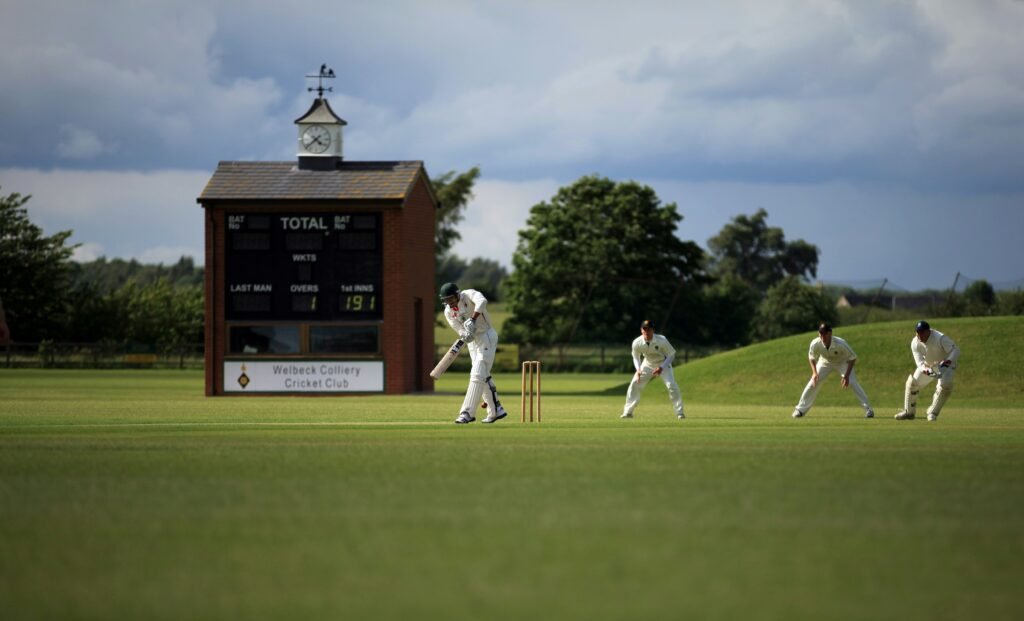
The cricket field is oval, with the pitch at its center. Fielders are placed depending on strategy—some close in to catch, others deeper to stop boundaries.
Typical Field Positions (Selected)
| Position | Location |
|---|---|
| Slip | Behind batter, to catch edges |
| Gully | Between slip and point |
| Point | Square on the off-side |
| Mid-off | In front of batter, off-side |
| Mid-on | In front, leg-side |
| Square leg | Square on the leg-side |
| Fine leg | Near boundary behind batter |
| Long on/Long off | Deep field near boundary |
| Wicketkeeper | Behind the stumps |
Field setting is a strategic art:
- Defensive fields have more players near the boundary.
- Attacking fields draw players closer for catches.
GLOSSARY OF TERMS
| Term | Meaning |
|---|---|
| Wicket | The wooden stumps and bails a bowler aims to hit. Also used to refer to a batsman’s dismissal. |
| Innings | A team’s or player’s turn to bat. |
| Bowler | Player who delivers the ball towards the batsman. |
| Batsman/Batter | Player who hits the ball to score runs. |
| Over | A set of six legal deliveries bowled by one bowler. |
| Run | The basic unit of scoring in cricket. |
| Pitch | The 22-yard central strip on the field where bowling and batting occur. |
| LBW (Leg Before Wicket) | A mode of dismissal where the ball hits the batter’s body (often leg) and would have struck the wicket. |
| Boundary | The edge of the playing field; hitting ball to boundary scores 4 (ground) or 6 (air). |
| County Cricket | Domestic first-class cricket competition in England and Wales. |
| ICC | International Cricket Council, global governing body. |
FORMATS OF CRICKET
| Format | Duration | Purpose |
|---|---|---|
| Test Cricket | 5 days | Longest, traditional format |
| One-Day Internationals (ODIs) | 50 overs per side | World Cup format |
| T20 Cricket | 20 overs per side | Fast, entertainment-focused |
The rise of televised T20 leagues—such as the Indian Premier League (IPL)—has greatly accelerated cricket’s global commercial growth.
THE ODI WORLD CUP: CHAMPIONS THROUGH THE YEARS
| Year | Host | Winner | Runner-Up |
|---|---|---|---|
| 1975 | England | West Indies | Australia |
| 1979 | England | West Indies | England |
| 1983 | England | India | West Indies |
| 1987 | India & Pakistan | Australia | England |
| 1992 | Australia & New Zealand | Pakistan | England |
| 1996 | Pakistan, India & Sri Lanka | Sri Lanka | Australia |
| 1999 | England | Australia | Pakistan |
| 2003 | South Africa | Australia | India |
| 2007 | West Indies | Australia | Sri Lanka |
| 2011 | India, Sri Lanka & Bangladesh | India | Sri Lanka |
| 2015 | Australia & New Zealand | Australia | New Zealand |
| 2019 | England & Wales | England | New Zealand |
| 2023 | India | Australia | India |
Australia remains the most successful team, with SIX TITLES.
How betting is damaging cricket
Integrity erosion
When illegal or corrupt betting becomes part of the game, it undermines the integrity of cricket. Fans assume that the contest is fair, unknown, and unpredictable. But if players, officials or ground-staff are influenced by betting interests, then the outcome or parts of it can be manipulated — making the sport less genuine. For example, the International Cricket Council (ICC) states that they welcome information about match-fixing, gambling in cricket and corrupt approaches.
Match-fixing and spot-fixing
There are two main ways betting corrupts:
- Match-fixing: where entire matches are influenced (for example to finish in a draw, or a particular team to lose).
- Spot-fixing: where specific events inside a match (for instance a certain bowler bowling a no-ball at a specified time) are manipulated because betting markets exist for those specific outcomes.
Spot-fixing is particularly pernicious because it can happen without large-scale collusion and is harder to detect — yet still devastating for trust in the sport.
Globalisation of betting markets and vulnerability
With the rise of online and cross-border betting, match-fixers can find new markets, making detection harder. As one commentary puts it: “The growth of Internet gambling and increased variety of betting options … resulted in the emergence of spot-fixing.”
This means that even domestic games, club matches, youth tournaments can become targets — not just high-profile internationals.
Regions, countries and incidents of concern
While betting corruption can occur anywhere, some regions have seen more high-profile cases and systemic risk. Here are some of them:
South Asia (Pakistan, India, Sri Lanka)
The well-known Pakistan national cricket team spot-fixing scandal of 2010 involved players taking bribes to bowl no-balls at pre-arranged times.
In Sri Lanka, a major allegation of pitch-fixing emerged in 2018, involving the groundsman at Galle International Stadium who admitted altering the pitch for bookmakers’ benefit.
India remains vulnerable because of large informal betting markets, though some of the most visible scandals are in other countries.
United Kingdom / England & Wales
- Even within the home of cricket, issues arise: e.g., the Brydon Carse case (England fast-bowler) was banned for placing hundreds of bets between 2017-19.
- The UK’s betting regulation, large betting market and global reach of its game make it potentially exposed.
Other regions
- Domestic leagues and lesser-known competitions (including in associate nations) often have weaker oversight, making them more at risk.
- Bookmakers, fixers and laundering may occur across borders, with money flowing through jurisdictions with weak enforcement. The Al Jazeera investigation noted that fixers in Sri Lanka had links to bookmakers based in the Middle East.
Why the problem persists
- High money, low risk: The margin of profit for bookmakers is very large and the ability to fix small events (e.g., a no-ball) gives a low-visibility entry point for corruption.
- Complex supply-chain: Fixing may involve groundsmen, curators, players, officials, bookies; this complexity makes detection harder.
- Weak governance in some places: Not all domestic boards have robust anti-corruption infrastructure, especially in smaller cricket-playing nations.
- Technology & online markets: The globalisation of betting and online markets increases reach and complicates regulation.
- Cultural & economic pressures: In countries where players/officials may be poorly paid or under-resourced, the temptation or coercion to engage in corrupt betting increases.
What’s being done
- The ICC’s Anti-Corruption Unit (ACU) exists to investigate, monitor and deter corruption.
- National boards (such as the England and Wales Cricket Board (ECB), Board of Control for Cricket in India (BCCI), etc) have codes of conduct and rules forbidding players and officials from betting on cricket.
- Education programmes for players/officials to recognise corrupt approaches.
- Use of data analytics in betting markets to detect unusual patterns (spot-fixing risk).
- More recent calls to regulate or legalise betting in some jurisdictions to bring transparency. (For example the 2012 Emory Law Review article “Saving Cricket: A Proposal for the Legalization of Gambling in India to Regulate Corrupt Betting Practices in Cricket”.)
THE CONTINUING GLOBAL JOURNEY
Despite all the odds, the Cricket’s story is ongoing. Nations like Zimbabwe, Afghanistan, Ireland, and Bangladesh have risen rapidly, providing powerful new narratives. The sport continues to blend tradition with innovation—balancing timeless Test matches with the fireworks of T20 leagues.
Yet, whether in the roaring stands of Kolkata, the sun-baked ovals of Sydney, or the village greens of Kent, the essence remains unchanged: bat, ball, field, patience, and joy.
Cricket is not just a sport; it is culture, heritage, community, and identity.